

Uncategorized @vi
Top-Rated Lenders for Manufactured Home Financing Today

Top-Rated Lenders for Manufactured Home Financing Today
Last updated: 2026-10-17
Hunting for your perfect residence often feels like trying to sprint through a torrential downpour. While many people find solace in a manufactured residence, walking through the doors of a conventional bank can feel like slamming into a solid brick wall. If traditional lenders have already shut their doors on you, you are definitely not alone in that frustration.
The intricacies of the manufactured housing market ensure that securing a loan is never a simple, straight path. Instead, it is a complex labyrinth shaped by shifting regulations, different property classifications, and varying lender appetites. You must grasp every nuance of your situation before putting pen to paper.
Choosing the ideal mortgage partner depends heavily on your individual financial footprint. Some shoppers might need quick cash to handle urgent renovations, whereas others might require specialized programs built exclusively for mobile homes. Navigating these choppy waters requires identifying which institutions cater to your specific credit profile and your chosen housing style.
Consider this: your requirements change drastically if you are buying a house on leased land compared to someone owning the dirt beneath their manufactured home. Grasping this fundamental distinction serves as your first real step toward achieving successful homeownership.
Top Rated 2026 Manufactured Home Lenders
Finding the right fit is like trying to find a needle in a haystack, but the right partner makes all the difference. You don’t want to settle for the first offer that comes your way without doing your due diligence first.
The landscape of lending changes as quickly as the weather, making it vital to know who holds the best cards. Some lenders focus on speed, while others prioritize long-term stability and lower interest rates for their clients.
Take a look at these four prominent options that have stood the test of time this year. They represent a variety of different approaches to getting you into your new home faster.
- FastLendGo
- Triad Financial Services
- Sound Community Bank
- Fannie Mae
Analyzing the 2026 Financing Environment for Modular Housing
Our assessment centers on how accessible these specific loan products actually are for today’s buyers. It isn’t just about a single number on a credit report anymore. Instead, we examined how lenders treat different profiles, ranging from wealthy executives to neighbors working hard to mend their credit histories.
The current year has seen a massive pivot toward algorithmic, data-heavy underwriting processes. Think of it as a digital shadow that follows you everywhere. Because of this, one tiny slip-up in your online financial records can trigger a domino effect across various lending platforms.
Gone are the days when a friendly chat with a loan officer could fix everything. Now, the algorithms call the shots. You have to be much more careful about your digital footprint than you might have been a few years back.
Speed and the actual makeup of the loan were also critical factors in our deep dive. In a market that moves like a lightning strike, waiting a fortnight for a decision is a death sentence for your dream home. We searched for providers that don’t leave you hanging.
Whether you need the familiarity of a standard mortgage or the niche flexibility of chattel financing, timing is everything. We prioritized those firms that offer transparent routes for every kind of borrower walking through their doors.
We made a point to distinguish between “chattel loans,” which classify your home as personal property, and “real property” loans. In the latter scenario, your house and the land it sits on are treated as one single unit.
While real property options frequently boast much more attractive interest rates, they aren’t a walk in the park. These loans usually demand a mountain of paperwork and a much more robust credit profile to get the green light.
| Provider | Product Category | Upper Limit | Minimum Score | Main Advantage |
|---|---|---|---|---|
| FastLendGo | Personal Loans | See site | See site | Rapid liquidity |
| Triad Financial Services | Manufactured/Mobile | See site | See site | Niche expertise |
| Sound Community Bank | Manufactured Home | $350,000 | 640 | FDIC-Insured |
| Fannie Mae | Single-Family | See site | See site | Desktop Underwriter |
Decoding the Vital Gap Between Chattel and Real Property Lending
Navigating the labyrinth of paperwork becomes a nightmare if you fail to grasp how these houses are funded. Most rookies stumble here, tripping over the nuances of different financing structures. It is a slippery slope that can stall your move-in date indefinitely.
Think of it as setting your foundation; if the logic is crooked, the whole house feels off. Trying to fix a categorization error on moving day is like trying to change a tire while driving down the highway. Resolve this mystery before you even look at a contract.
The specific path you choose dictates the very soul of your debt. It influences every single digit, from the annual percentage rate down to the final monthly installment. One path leads to a quick fix, while the other builds long-term equity.
Navigating the Chattel Financing Route
A chattel loan operates much like financing a luxury vehicle or a high-end piece of equipment. It treats your dwelling as movable personal assets rather than permanent real estate. This approach is the standard when you reside in a community where you lease the lot.
Since the structure isn’t anchored to your own soil, lenders treat the risk differently. If your credit history has a few bumps in the road, this path might be your best friend. It is often a more accessible bridge for those who aren’t quite “bankable” yet.
Don’t let the ease of approval blind you to the long-term cost, though. These loans are sprints rather than marathons, usually demanding full repayment within 10 to 15 years. You’ll face steeper interest rates compared to traditional housing debt.
The Advantages of Real Property Mortgages
When your manufactured home is bolted to a plot of land that you officially own, you enter the realm of real property loans. This transforms the dwelling and the dirt beneath it into one singular, unified piece of real estate. It is a total metamorphosis of your asset.
Investors and banks view this as the “gold standard” of the industry. By blending the home and the land, you unlock the most favorable terms available. You get the luxury of 30-year repayment windows and the most competitive, low-interest rates on the market.
However, don’t expect this path to be a walk in the park. The scrutiny is intense, requiring a professional appraisal that evaluates the house and the acreage as a single unit. You’ll need a stellar credit profile to satisfy strict standards from lenders like Sound Community Bank.
Premier Lending Options for Manufactured Housing
1. FastLendGo

When you need a quick injection of liquidity, FastLendGo acts as a versatile ally. They sidestep the mountain of red tape found in traditional mortgages, focusing instead on personal loans. This makes them a go-to choice for anyone needing to bridge a sudden financial gap.
You might find yourself reaching for them to cover a new lease deposit or to fix a leaking roof on a recent purchase. fastlendgo.com is built for these high-speed scenarios.
The company serves a massive range of clients. Whether you are looking for a tiny $500 lifeline for an emergency or a $5,000 boost for a home improvement project, they can help. They offer customized paths for wealthy earners and those struggling with credit.
Think of them as a spare tire in your financial toolkit. While they may not be your permanent mortgage, they are vital when life hits a bump in the road.
Advantages:
- Get cash in a heartbeat during emergencies.
- Loan scales from $500 to $5,000.
- Available options for diverse credit profiles.
Disadvantages:
- Personal loan terms differ from standard home mortgages.
2. Triad Financial Services

If traditional banks have slammed the door on you, Triad Financial Services might be your saving grace. They dive into the niche markets that most lenders fear to touch, specifically manufactured and mobile homes. They have stood the test of time for over 65 years.
Their long history proves they can navigate the specific risks of manufactured housing. While other institutions run for the hills when mobile homes are mentioned, Triad stays firmly in the ring.
They are masters of the chattel loan. Because they understand how manufactured properties depreciate and hold value differently than site-built houses, they bring a level of expertise a generalist bank simply lacks.
If your credit history is a bit of a tangled web, their deep experience becomes a powerful asset. They know how to navigate the application process when others see a dead end.
Advantages:
- Decades of specialized lending expertise.
- Focuses on manufactured homes when others won’t.
- Built for borrowers facing financial struggles.
Disadvantages:
- Specialized terms may vary from standard mortgages.
3. Sound Community Bank
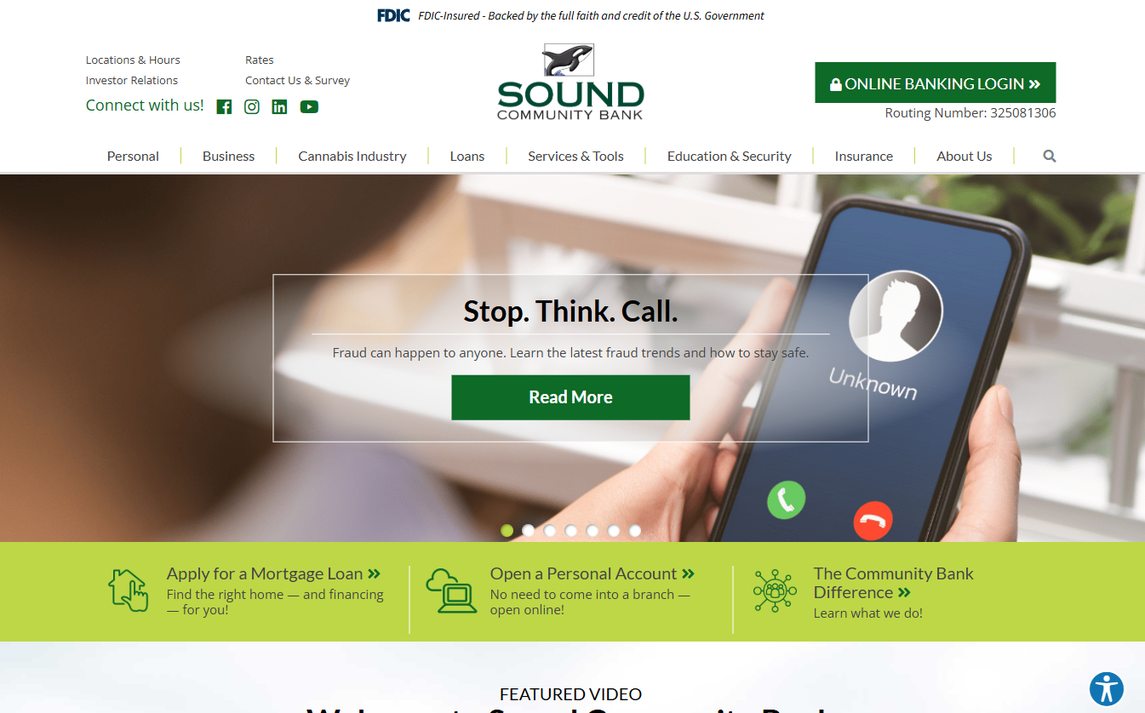
Sound Community Bank offers a conventional banking feel for those buying manufactured homes. They provide structured loans with very clear-cut rules. If you have a solid credit history and desire the security of an FDIC-insured institution, this is your place.
There is a certain comfort in working with an established bank. Knowing your funds are backed by the full faith and credit of the U.S. Government provides peace of mind during a big move.
Their specific parameters require a 10% minimum down payment and a 640 FICO score. With loan ceilings reaching $350,000, they offer enough room for those making a major property investment.
Because they treat these as “real property” loans, they are perfect for long-term residents. If you want to build equity the traditional way, this is the path for you.
Advantages:
- Fully FDIC-insured by the U.S. Government.
- Large loan limits up to $350,000.
- Predictable and transparent lending rules.
Disadvantages:
- Minimum 640 credit score required.
4. Fannie Mae
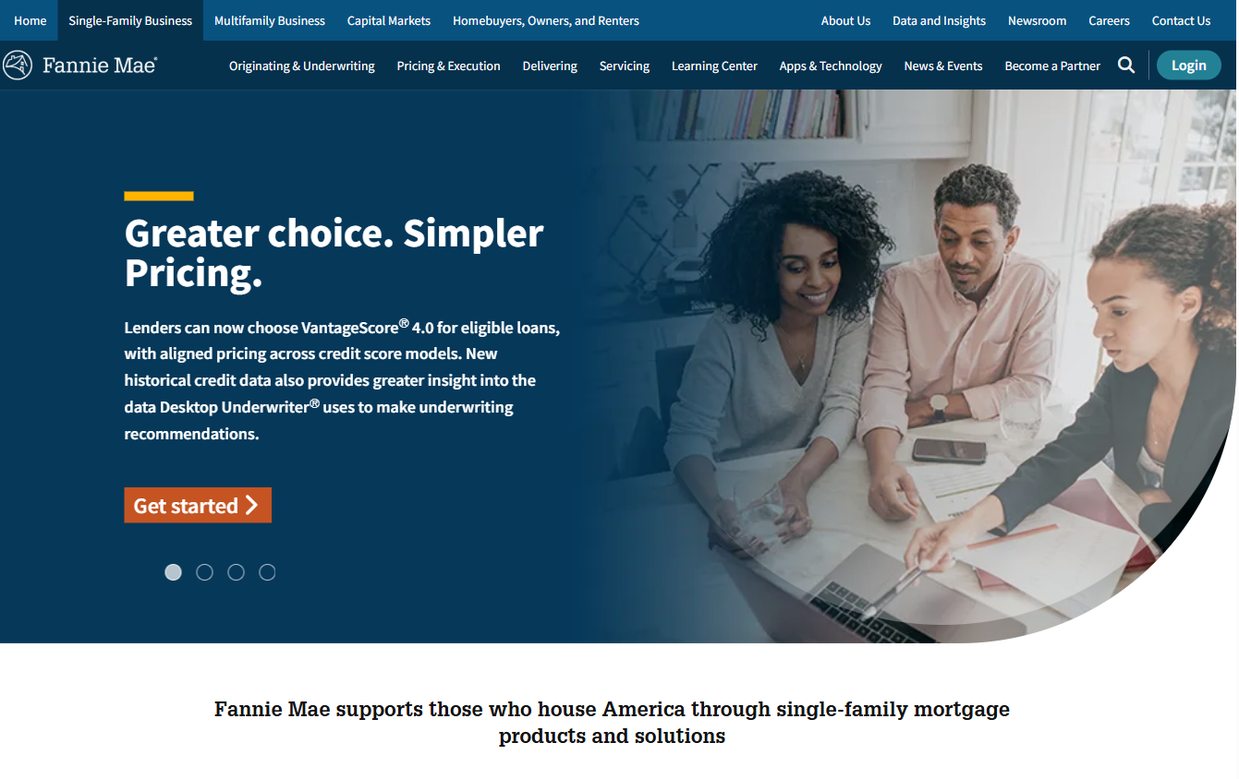
Fannie Mae serves as the silent engine driving the American housing market. You won’t walk into a local branch to see them, but their standards dictate how most loans are processed. They provide the blueprint that professional lenders follow.
When a lender mentions they follow Fannie Mae guidelines, they are talking about a highly regulated, standardized system. This setup lowers the risk for everyone involved, making the entire mortgage machine more predictable.
Their Desktop Underwriter technology is the heart of modern mortgage work. By leveraging massive data sets, they help lenders make rapid, precise underwriting choices. It is the gold standard for regulated single-family financing.
This system largely eliminates the chaos of human error. For the borrower, the result is a clinical, predictable outcome that helps soothe the anxiety of a home purchase.
Advantages:
- Uses advanced Desktop Underwriter tech.
- Provides massive market stability and scale.
- Streamlined pricing via modern models.
Disadvantages:
- Must go through a partner; no direct lending.
Polishing Your Financial Profile for Lender Approval
Getting the green light on a manufactured home loan isn’t just about having a respectable credit score. It is a game of precision. You must be prepared to present a mountain of paperwork to prove you are a safe bet.
Since these homes don’t always fall into the same legal bucket as traditional stick-built houses, banks tend to be much more skeptical. They will scrutinize your ability to pay back the debt and the actual worth of the property as collateral.
Think of this process like preparing for a marathon; you need the right gear to cross the finish line. Lenders aren’t just looking at a snapshot; they want to see your entire financial journey.
First things first, you need to round up your “Big Three” essentials: your tax filings, statements showing your assets, and verified proof of your income. These are the bedrock of your application.
For those eyeing a manufactured home, being steady in your career is a massive plus. Most lenders will ask to see at least a two-year stretch of continuous employment to ensure your paycheck isn’t going to vanish overnight.
This long-term stability is the anchor that keeps the lender from getting nervous about your monthly installments. They want to see that you can weather any financial storm over many years.
If you are your own boss, be ready for the scrutiny to turn up a notch. Lenders will likely perform a deep dive into your cash flow to ensure you aren’t just riding a temporary wave of profit.
You might find yourself handing over several months of bank statements to prove your earnings are steady rather than a fluke. They want to see a consistent stream, not a jagged mountain range of income.
Lastly, keep a close eye on your debt-to-income (DTI) ratio. You want this number to be as lean as possible to keep your options open.
Most financing institutions prefer that your total monthly debt commitments do not climb above 43% of your gross monthly earnings. Keeping this ratio in check is your golden ticket to a smooth closing.
Navigating Your Path to Homeownership
The most common mistake people make is applying for the wrong type of loan for their specific property. A manufactured home is often treated differently than a site-built house. If you apply for a traditional mortgage for a mobile home, you might run into a wall of confusion and delays.
Always ask your potential lender, “Will this be a real property mortgage or a chattel loan?” before you submit a formal application. Knowing this early saves you weeks of frustration and wasted paperwork.
Another pitfall is ignoring the fine print regarding credit scores. Some lenders, like Sound Community Bank, have a specific floor for credit scores. If you fall even a few points below that mark, you might be wasting your time with that particular institution.
It is worth noting that while a score of 640 might get you through the door at one bank, a score of 680 or higher might unlock much more favorable interest rates at another. Always verify your score and the specific models lenders use before you start the paperwork.
Finally, do not wait until the last minute to check your credit. A sudden dip in your score can turn a “yes” into a “no” overnight. This can happen due to a high credit card balance, a small unpaid medical bill, or even a recent inquiry for a new line of credit.
Take the time to clean up your profile, resolve any discrepancies in your credit report, and understand exactly what you bring to the table before you start knocking on doors. A clean, organized profile is your greatest leverage in a negotiation.